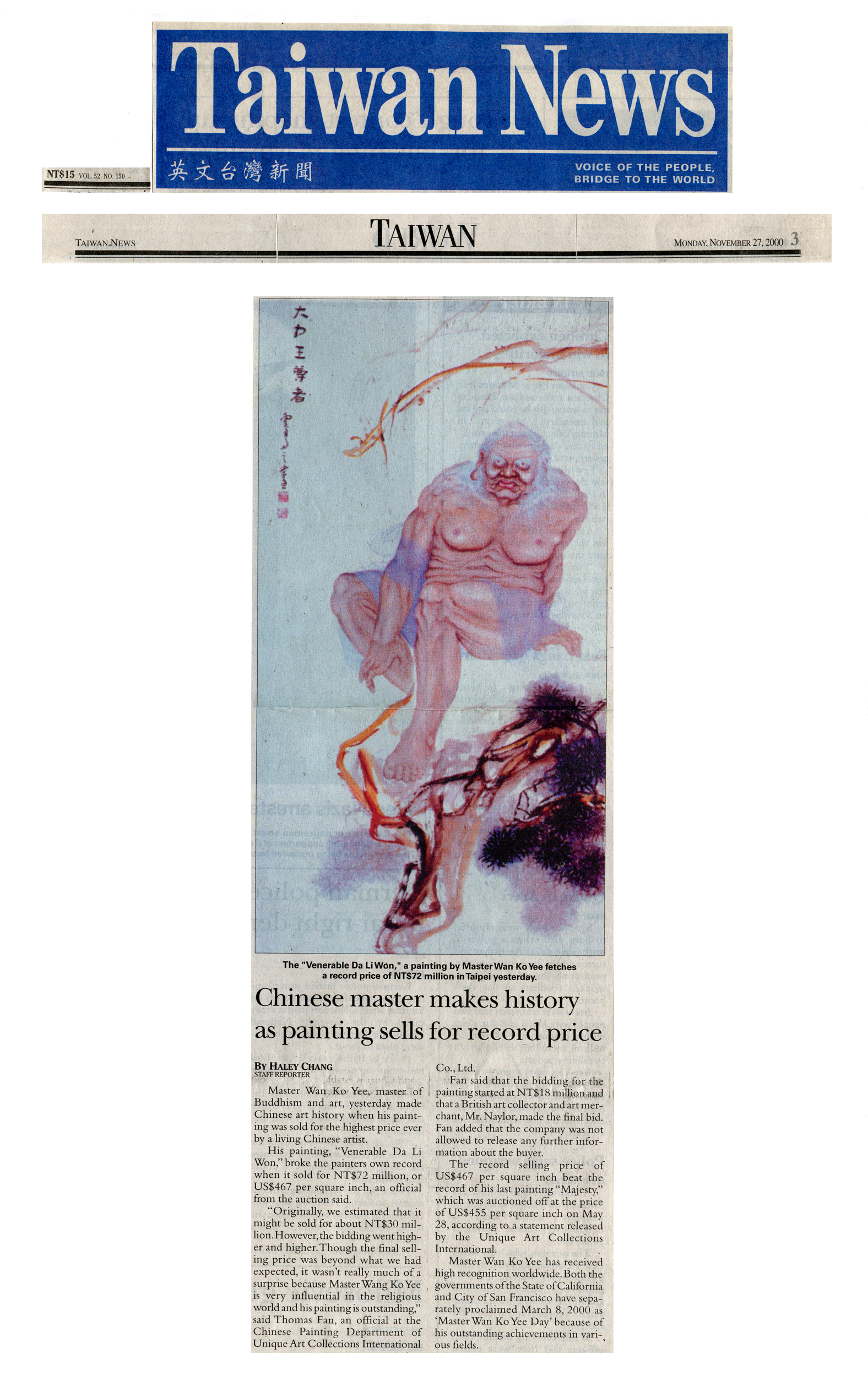
H.H. Dorje Chang Buddha III — Discovering the Root of Buddhism | CEC-TV (Please Turn On English Subtitles)

Program Broadcast on the China International Education TV– Probe the Fundamental Origin of Propagating True Buddha Dharma
Focus on Pioneers
Cherishing a compassionate mind, bringing peace and harmony to living beings, being ardently respected by humans and heavenly beings alike, and engaging in the undertaking of broadly saving living beings, He is the genuine incarnation of primordial Sambhogakaya Buddha, Dorje Chang Buddha.
He is the first Buddha in the history of Buddhism of several thousand years who does not accept offerings. He imparts the Dharma in common and easy-to-understand language, enabling listeners to achieve awakening of different depths depending on their own background and ability. His accomplishments in the Five Vidyas are the best in the history of Buddhism.
He is H.H. Dorje Chang Buddha III.
In this session of our program, we will together step onto the journey of discovery to reach the fundamental root of Buddhism, from which true Buddha Dharma is propagated.

Buddhism and Its Role in Human Civilization
Through the ever-flowing long river of human history, what can last long is culture. Within the domain of culture, religious aspiration has the longest, widest, and deepest influence.
Looking through the history of the world since ancient time, you will discover that Buddhism, as a world-wide religion, has not only been an important force for the stability and development of society, but more importantly, also played a pioneering role in cultural development and advancement of civilization.
Xiong Wenli (Professor of Buddhist study, Hua Zang Buddhist Institute):
There are very many philosophical schools and sects in the world, but these philosophical schools and sects basically all start from the individuals’ subjective opinion. That is why, among so many philosophical schools and sects currently in society, there exist very many debates and controversies. This is the reason for such a situation.
However, the world view and methodology of Buddhism are different. They do not start from subjectivity and instead are established on the foundation of reality and the absolute truth of the universe. Therefore, that constitutes the type of the most scientific, the most objective, the most perfect, and the best world view and methodology.
Among the world’s multi-aspect cultural entities, Buddhism, by its unique duality of aspiration of transcending the world and feeling of concern about the world, has been evolving more and more into a spirit of humanity to guide and lead the world’s cultural development and to save the fate of mankind.
Exactly because of this, Buddha Dharma for attaining supreme, equal-minded, and perfect enlightenment is utmost important. Then, the ability to propagate the true Dharma of the Tathagatas is even more so a kind of greatly good karmic condition, a kind of great virtue.

The Dharma Teachings of H.H. Dorje Chang Buddha III
Dharma Master Shi Ruohui (Abbess of Hua Zang Si):
The coming of H.H. Dorje Chang Buddha III to this world brings the perfect and complete true Dharma of the Tathagatas. The goal is to help living beings cultivate themselves through learning from Buddha, in order to attain accomplishment and liberation.
For several decades, His Holiness the Buddha worked tirelessly day and night to compassionately edify living beings.
Since His Holiness the Buddha sees the fundamental nature of living beings thoroughly, He uses simple and explicit language to explain loft and profound Buddhist principles clearly in the process of teaching. Therefore, those who listen to the Dharma can understand at different depths based on their current background and enter deeper step by step. Eventually, they will be able to comprehend, realize, and awaken to the precious essence of the Tripitaka.
In addition to expounding the supreme absolute truth of the universe and human life, many teachings of His Holiness the Buddha also apply expedient means, provide guidance to cultivation, emphasize the importance of cultivation as well as its relationship with practicing the Dharma, and give many examples about the truth that the law of cause and effect never errs or ceases.
Whether the listeners are sect leaders, great holy virtuous persons, and great Dharma masters within the Buddhist world or even people of all walks in society, all have received innumerably many benefits after listening to the Dharma. Moreover, they are full of admirations to His Holiness the Buddha.
H.H. Dorje Chang Buddha III is the genuine incarnation in this world of the primordial Sambhogakaya Buddha, Dorje Chang Buddha.
Within the universe, all Buddhas and Bodhisattvas become Buddhas and Bodhisattvas by learning the Buddha Dharma of Dorje Chang Buddha.
For the first time in the history of Buddhism, H.H. Dorje Chang Buddha III publicized those erroneous views and evil views, totaling 128. The purpose is to restore the intrinsic essence of Buddha Dharma by emphasizing cultivation as the foundation of attaining accomplishment.
As of now, numerous disciples of H.H. Dorje Chang Buddha III have attained accomplishment. Moreover, the status of H.H. Dorje Chang Buddha III as a Buddha was universally recognized and corroborated by leaders of major sects of Buddhism.
Understanding the Concept of a Buddha
Dharma Master Shi Zhengda (Chief Teacher for Correctly Listening to Dharma Discourses, the World Buddhism Association Headquarters):
What is the concept of Buddha?
That is simply the supreme, equal-minded, and perfect enlightenment, or Anuttara-samyak-sambodhi. That is, Buddha has completely and thoroughly realized the absolute truth of human life and the universe.
The concept is that Buddha has the same lifespan as the heaven and is united as one entity with the universe. Therefore, I will not be able to describe it completely even if I speak for several days or several years.
To completely, truly, and thoroughly understand the absolute truth of Buddha Dharma, what must we read?
That will be the Buddhist books of H.H. Dorje Chang Buddha III, such as Imparting the Absolute Truth through the Heart Sutra, the Supreme and Unsurpassable Mahamudra of Liberation, the Sutra on Understanding the Definitive Truth, Dharma of Cultivation, Precious Essence of Buddha Dharma and others.
There are also recorded audio Dharma discourses expounded by the Buddha Master that are recorded on several thousand audio CDs. These Dharma discourses on several thousand audio CDs are in fact several thousand sutras since they have come to the world with His Holiness the Buddha.
As we can see in today’s world, chaotic situations are rising abundantly within Buddhism. Correct Buddha Dharma and holy virtuous Buddhists are very rare within the Buddhist world.
In order to liberate living beings and correctly restore Buddha Dharma, the beginning-less primordial H.H. Dorje Chang Buddha III has come to our saha world, bringing pure and complete Buddha Dharma to living beings.
The teachings of the world-honored Shakyamuni, the supreme leader of Buddhism in the saha world, have now been restored.
The Study of Buddhism and Buddha Dharma
Dharma Master Shi Xiangkuizhi (Head, Pagoda Temple, Los Angeles, USA):
I came from Taiwan. While in Taiwan, I founded a Buddhist academy. I also taught in the Buddhist academy, but what I taught was essentially the study of Buddhism.
Only when I entered deeper, did I know that the study of Buddhism was a totally different domain from Buddha Dharma.
That was why as I was teaching at the Buddhist academy, when real issues arose, I did not have any way to deal with them. This was because of the lack of Buddha Dharma.
Therefore, once I learned that a true Buddha is residing in our world, I made a vow. Whatever it may take, I must become the Buddha’s disciple to learn true Buddha Dharma.
Otherwise, how could I help living beings and benefit living beings as a Buddhist monastic? Without Buddha Dharma, one can only have hollow theories.
I have been close to the Buddha Master for nearly 20 years. What I saw and heard while being near the Buddha Master are exactly the states of realization and true Buddha Dharma that I read from the Tripitaka in the past.
Therefore, H.H. Dorje Chang Buddha III’s coming to our saha world is for correcting the Dharma.

The Five Vidyas
According to Buddhism, all kinds of knowledge within the universe are categorically summarized into five types. A complete mastery of achieving the highest level of a field is called a vidya, or brightness. That is how the Five Vidyas are defined in Buddhism.
Shakyamuni Buddha stipulated that all Bodhisattvas must possess the Five Vidyas. Furthermore, A Buddha is the king of the Five Vidyas.
When you walk into H.H. Dorje Chang Buddha III Cultural and Art Museum, you will find all the answers from the environment you are personally experiencing.
Dharma Master Shi Zhizhuang:
Throughout the history of Buddhism of several thousand years, the accomplishments of H.H. Dorje Chang Buddha III, who is familiar to and respected by us, in the Five Vidyas are the best and highest.
Then, what is implied in this status of being the best and highest?
It shows that Buddha knows about and have the ability to do all things in the universe and also introduces and transmits such knowledge and morality to Buddhist disciples, to guide and lead them to get onto the path of acquiring morality, education, and knowledge and thereby advance the development of civilization and progress through time in the entire world.
H.H. Dorje Chang Buddha III once openly told people that, during a period of five years, H.H. Dorje Chang Buddha III would answer any and all questions raised by any people and there would be no question that He could not answer.
You can all think, what concept is this?
If not having the ability to include the universe like a small object and hold Mt. Sumeru in a palm, would He be able to say such words?
More importantly, H.H. Dorje Chang Buddha III brought the complete Buddha Dharma, Buddhist teaching, and the study of Buddhism that are pure, correct, and impartial and corrected the Buddhism that had been mispresented by patriarchs and tainted by heretic practitioners.

Training Buddhists to Propagate the Dharma
However, currently, many Buddhist sites propagating true Buddha Dharma are faced with the reality of lacking qualified Buddhists for propagating the Dharma and having different qualities among Buddhists.
For that, quite a few Buddhist institutes have been established in Los Angeles and San Francisco in the state of California of the United States, to develop and train Buddhist with excellent qualities, to ensure that the perfect and complete Buddhist teachings and Buddha Dharma of H.H. Dorje Chang Buddha III can be correctly transmitted to the public without deviation.
Dharma Master Shi Longhui (Chairperson, the International Buddhism Sangha Association):
Many people from various places or overseas come to our Buddhist institute to study, learning from the Dharma expounded by His Holiness the Buddha. They all feel that they have received very great benefits. That is why they traveled thousands of miles to come and study.
Since the Supreme and Unsurpassable Mahamudra of Liberation is the biggest and greatest Dharma that Buddha Master brought to our saha world in this lifetime, everyone has attained one’s own benefits after learning.
I hope that we can all serve the society in good ways and become kind citizens.
His Holiness the Buddha taught us that Buddhist disciples must carefully consider and care about living beings’ interests.
Masters of Dharma-listening sessions take an examination and will then, at where they are, lead those who wish to respectfully listen to the recorded audio Dharma discourses expounded by His Holiness the Buddha, to learn how to become a true Buddhist and how to become a best cultivator.
The Buddhist institutes are international organizations for training and developing people with talent in Buddhism. The goal is to educate those who truly want to learn from Buddha into excellent Buddhist scholars with correct understanding and views and possessing truly cultivated realization.
They will clearly believe in the law of cause and effect, being free of hollow and baseless dogmas and feudal superstition and belief in strange and paranormal phenomena.
Teachings for the Modern World
Ven. Mozhi (Gold Button Grade II Holy Virtuous One):
Not only are the teachings of His Holiness Dorje Chang Buddha III in complete accordance with Shakyamuni Buddha, but they are even more incisive.
Not only are the teachings the same as Shakyamuni Buddha, but they are also more succinct, understandable, and direct.
His Holiness the Buddha demonstrated the irreplaceable positive role played by Buddhist culture in this new era of perfectly harmonizing the splendid assembly of world culture.
His Holiness the Buddha wholeheartedly focuses on giving and never accepts any offering, providing a propelling force for elevating morality, progress of civilization, and cultural development of whole society.
Henghsing Gyatso Rinpoche:
H.H. Dorje Chang Buddha III came to the world with the supreme Buddha Dharma, the Supreme and Unsurpassable Mahamudra of Liberation.
This is the gospel of good fortune for the entirety of humanity. This is because, if each of us, whether you are a Buddhist or not, whether you have a religious belief or not, can earnestly learn from the Supreme and Unsurpassable Mahamudra of Liberation, then we will all become the best people of kindness.
Then, as we live in this world, it will be an auspicious, harmonic, thriving, prosperous, stable, and peaceful world.
Buddhism, Inclusiveness, and Harmony
The world’s economic and cultural mode has already entered a modern and international era.
To adapt to the internationalized setting, H.H. Dorje Chang Buddha III enriched the inner connotation of Buddhist culture, to let it play an important role in reconciling various thoughts, breaking all kinds of closed ideologies, and promoting the development of civilization and advancement of the current era.
Zhaxi Zhuoma Rinpoche (President, Xuanfa University):
His Holiness Dorje Chang Buddha III has told us we must work to uphold the laws and aspirations of our nations and live together in harmony with others.
I think the other unique and powerful influence of Buddhism is that it is inclusive. It is inclusive of all.
And, that way, we can have influence over other religions and belief systems. But since it doesn’t promote dogma or teach that other belief systems are intrinsically evil, we can live in harmony with many different groups.
Benefiting Living Beings
Through the many years, H.H. Dorje Chang Buddha III taught and transmitted sacred Buddha Dharma to disciples in person.
By practicing in accordance with the Dharma, not only can the disciples receive perfect benefits and happiness in real life, but many of them were able to attain rebirth in Buddha-land, freedom from birth and death, and even higher states of realization.
H.H. Dorje Chang Buddha III wholeheartedly cares about living beings, teaches them by words and deeds, and is always on the path of benefiting living beings.
Link: https://myhappylifestyle.net/2026/09/29/h-h-dorje-chang-buddha-iii-discovering-the-root-of-buddhism/
#DorjeChangBuddhaIII #Spirituality #Buddha #Buddhism