Where Do the Eight Sufferings of Life Come From, and Where Do They Lead?
Day: November 9, 2026
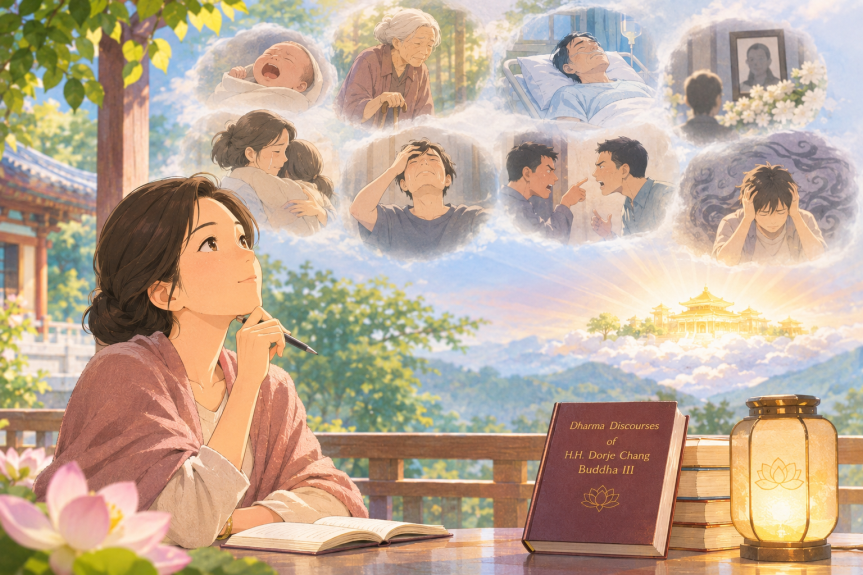
Where Do the Eight Sufferings of Life Come From, and Where Do They Lead?
Do you often feel that your life is filled with troubles and that Heaven has treated you unfairly? Do you frequently envy others for their wealth and successful children, while feeling that you have nothing? Do you often complain that your superiors are incompetent, yet arrogantly use their authority to oppress and exploit you?
Namo Shakyamuni Buddha taught that there are eight sufferings in life: birth, aging, sickness, death, separation from loved ones, being unable to obtain what one desires, encountering those one dislikes or resents, and the suffering arising from the intense activity of the five aggregates.
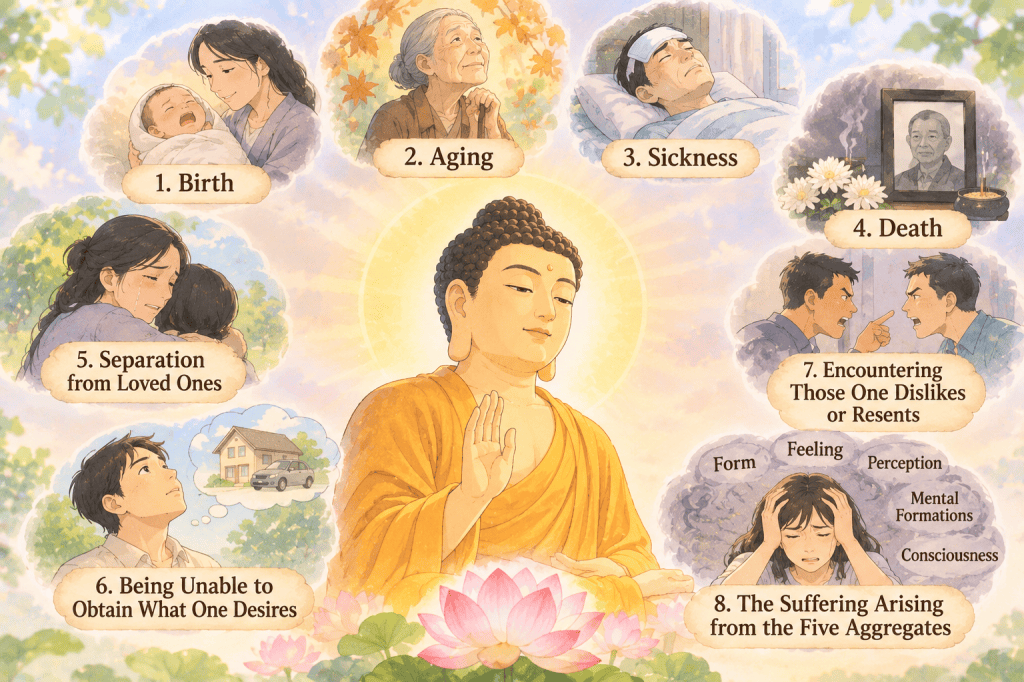
These eight sufferings follow us like shadows and are deeply intertwined with our daily lives. That is why we frequently experience pain, distress, and oppression. This should come as no surprise. From the moment a person is born, or even while still in the mother’s womb, suffering and torment are already present. Only occasionally, in the brief intervals between sufferings, do we experience fleeting moments of happiness.
As we drift and struggle in the ocean of suffering, what exactly are we hoping to gain?
An extraordinarily beautiful woman? No matter how beautiful she may be, her beauty will eventually fade with the passing years.
Unlimited power and authority? No matter how powerful a person becomes, no one can escape death or attain eternal life through worldly power.
Mountains of wealth? Even if one possesses riches comparable to those of an entire nation, such wealth is only temporarily held.
Romantic love? In life, we often encounter the suffering of separation from loved ones and the suffering of meeting those we resent. In the face of death, even the most deeply devoted lovers must eventually part.
I could not help but look up to the heavens and sigh: Why must we suffer so much? We come into this world, endure countless hardships, and ultimately leave with nothing. Then what is the meaning of all this suffering?
With these questions weighing heavily on my mind, I began a painstaking search for answers.
I studied traditional Chinese culture, hoping to find the key to these questions within the profound wisdom accumulated over thousands of years of Chinese civilization. Confucian teachings and Taoist cultivation both seek peace and stability in this present life, but can such peace and stability truly be relied upon? The shadow of suffering still looms behind every one of us.
I also tried to find answers in Christianity, but cultural differences soon led me to abandon that pursuit.
Finally, I turned to the vast and profound teachings of Buddhism. I visited many temples, met numerous monastics wearing Buddhist robes, and studied a great deal of Buddhist knowledge online. Despite my persistent search, however, I gained very little understanding.
Through the coming together of causes and conditions, I was fortunate enough to encounter the authentic Buddhist teachings transmitted by Namo H.H. Dorje Chang Buddha III.
The teachings of Namo H.H. Dorje Chang Buddha III were like a bright lamp illuminating the darkness, enabling me to penetrate the mysteries behind the countless sufferings of life.
I finally came to understand that the root of all our suffering is attachment to self (self-attachment), and that self-attachment is the root of reincarnation.
Because we are afflicted by the five poisons—greed, anger, ignorance, arrogance, and doubt—we remain entangled in self-attachment throughout countless lifetimes. As a result, we continue to endure torment in the ocean of suffering within the cycle of reincarnation.
Therefore, eliminating self-attachment is the foremost priority in learning Buddhism.
No wonder we suffer so much! All along, we have been troubled, deluded, and obstructed by our attachment to the self.
Eliminating self-attachment is an urgent task for every Buddhist practitioner. Yet self-attachment follows us at every moment. How difficult it is to eliminate!
What, then, should we do?
We should constantly and respectfully listen to the Dharma discourses of Namo H.H. Dorje Chang Buddha III and respectfully study authentic, precious Dharma books.
With the Buddha residing in this world, we should take the Buddha as our teacher, follow the Buddha’s teachings and precepts, and cultivate ourselves in accordance with the Dharma.
By doing so, we can gradually free ourselves from the self-attachment that has bound us throughout countless lifetimes, untie the knots of reincarnation, transform causes and effects, and progress from self-cultivation to Dharma practice. Ultimately, we can attain liberation and accomplishment and reach the realm of happiness—the Pure Land.
Are you still searching for the true meaning of life, or have you already embarked upon the path to Bodhi?
Written by Mei Fang
Link: https://myhappylifestyle.net/2026/11/09/dorjechangbuddhaiii-eight-sufferings-of-life/
#DorjeChangBuddhaIII #Spirituality #Buddha #Buddhism
